
Is Recreational Marijuana Quietly Affecting Your Marriage?
By Dr. David Marine Mabry
Encompass Executive Director
Is Recreational Marijuana Quietly Affecting Your Marriage?
Recreational marijuana has become part of the daily landscape for millions of American couples. It is legal in most states. It is normalized in popular culture. And for many people, it feels like a harmless way to unwind at the end of a long day.
But in my work with couples at Encompass Connection Center, I keep hearing a version of the same story. One partner feels like the other isn't really there. Conversations that should be simple turn into arguments — or get avoided altogether. Something has shifted, and neither person can quite name what it is.
Sometimes, after we spend time together, the question quietly surfaces: could recreational marijuana be part of what's happening here?
If that question has crossed your mind — about your own use, your partner's use, or what the two of you have stopped talking about — this is worth reading.
The Gap Between How Things Feel and How They Are
One of the most striking findings in recent research on cannabis and couples is what researchers call a perception gap. In a study of 145 couples where at least one partner used cannabis regularly, trained observers watched couples work through real conflict discussions. They rated each couple's conflict behavior independently — without knowing anything about cannabis use levels.
What they found was consistent and significant. The more frequently a partner used cannabis, the less effective their conflict behavior was by every observable measure: more criticism, more avoidance, less ability to de-escalate and recover. And yet — those same partners reported feeling more satisfied with how the conflict went than their behavior actually warranted.
In other words: frequent cannabis use was linked to a genuine gap between how couples think they're doing and how they're actually doing.
This matters because good relationships require honest feedback. When we think a hard conversation went well — when we feel fine — we stop looking for what might need to change. The gap stays invisible. Until it isn't.
"Frequent cannabis use was associated with more criticism, more avoidance, and less ability to recover from conflict — while partners simultaneously reported feeling satisfied with how the conversation went."
When Partners Are on Different Pages
The research on marijuana and relationships consistently points to one pattern above others: when partners differ significantly in how often or how much they use, the relational cost tends to be measurable.
A 2025 study of 110 couples found that greater differences in partners' cannabis-use intensity were linked to lower relationship satisfaction and lower satisfaction with the quality of their intimate life together. A separate longitudinal study of couples followed over ten months found that when the gap between partners' use patterns was larger than usual for that couple, multiple measures of relationship functioning were poorer — regardless of which partner was the more frequent user.
Researchers who interviewed couples navigating this describe a recurring pattern: the non-using partner begins to feel lonely in a way that is hard to explain. Physically, their partner is present. Emotionally, something is harder to reach. Over time, concern can replace connection.
The non-using partner may also end up carrying more of the relationship's emotional weight — managing more of the difficult conversations, holding more of the household, staying more present with the children — while the dynamic between them quietly shifts in ways that neither has fully named.
What It Can Cost Over Time
Relationships are built on patterns more than moments. The daily and weekly habits that seem unremarkable — who is present at the end of the day, who follows through on what they said, how conflicts get handled and then resolved — these are what shape the trust and connection a marriage is made of.
Frequent recreational cannabis use has been associated in the research with reduced emotional availability, decreased follow-through on commitments, and a gradual emotional numbing that can dull both stress and joy. For couples with children, research has found links between parental cannabis use and more negative parenting patterns — with children's emotional and behavioral health affected downstream.
And perhaps most relevant to the long arc of a marriage: a study that followed participants from birth to age 38 found that people who used cannabis four or more days per week over many years experienced worsening financial, work-related, and relationship difficulties as the years progressed — even after accounting for other risk factors.
None of this means that every person who uses cannabis recreationally will experience every one of these outcomes. Research shows associations, not certainties. But when the couples sitting across from us are describing these exact patterns — the distance, the avoidance, the sense that something is being missed — the research gives us a language for what they are experiencing.
The Conversation Worth Having
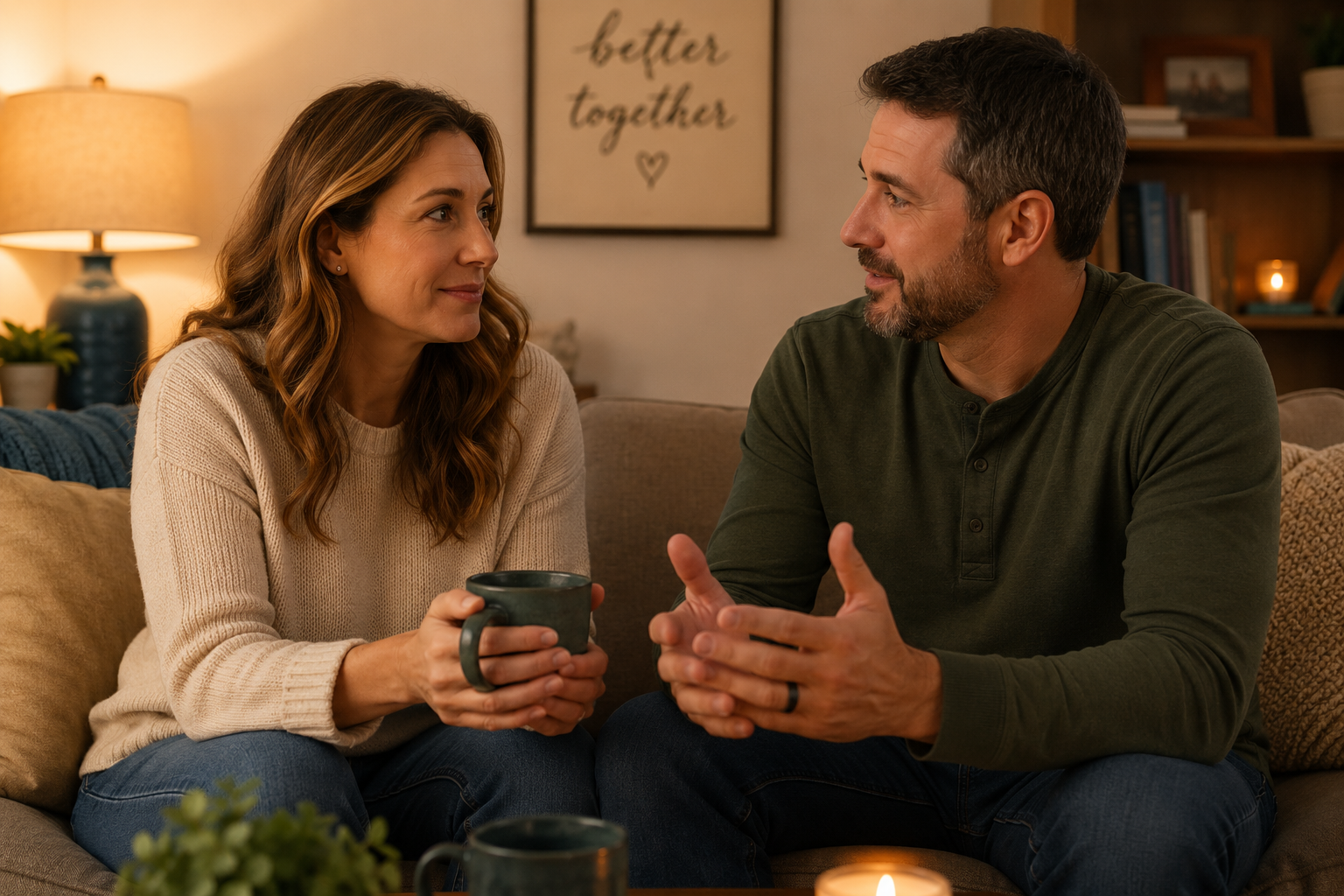
If any of this resonates — even as a quiet "what if" — the most important next step is not an argument. It is a conversation.
Not a conversation that begins with "you need to stop" or "it's not a big deal." Those conversations tend to end before they start. The conversation worth having is an honest one, had when both of you are clear-headed, about what each of you has noticed, what you each value, and what you want your marriage to look like.
That kind of conversation requires skills — the ability to say something hard without it becoming an attack, and the ability to hear something hard without shutting down. It requires emotional safety: the sense that telling the truth to your partner won't cost you the relationship.
Those are learnable skills. That is exactly what relationship education exists to offer.
At Encompass, we believe that the couples and families who build lasting connections are the ones willing to look honestly at the habits and patterns shaping their life together. Not with shame. Not with fear. But with the kind of clear-eyed care that says: this relationship matters enough to take seriously.
If marijuana has become a quiet question in your marriage, you don't have to figure it out alone. We would be glad to listen.
Ready to Build the Connection Your Marriage Deserves?
The RINGS Experience helps couples strengthen communication, navigate conflict, and rebuild emotional connection — with practical tools that work in real life.
• Learn skills for honest, safe conversations
• Understand patterns that may be creating distance
• Build the foundation your relationship was designed to have
→ Take the Free Relationship Assessment
→ Learn About the RINGS Experience
→ Schedule a Free Intake Conversation
"Many couples begin with a free conversation where we simply listen and help identify next steps. There is no pressure — just a practical starting point."