

By Dr. David Marine Mabry
Executive Director
Theresa and I don't just share a marriage. We share an office.
As co-directors of Encompass Connection Center, we work side by side most days, and we've learned that bringing work stress home is one of the easiest habits for a couple to fall into.
Here's what it often looks like for us. One of us has had a hard day: a tense meeting, a heavy conversation, a problem that won't let go. The other had a pretty good day.
We sit down to dinner, and the one with the easier day asks, "So how did that meeting go?" It's a caring question. But the one who's worn out needs a break from work talk, not a replay of it.
Without meaning to, we end up on different pages. If that sounds familiar, you're not alone. It happens in healthy marriages all the time, and couples can learn to handle it well.
Why Work Stress Follows Us Home
Researchers call this stress spillover. One well-known study found that a stressful day at work tends to be followed by more tension at home that evening (Bolger et al., 1989).
For some people, the load is heavier. Nurses, teachers, first responders, pastors, counselors, and family caregivers spend their days with people in their hardest moments.
Over time, other people's pain can start living in you. Even if your job isn't like that, you probably know what it's like to carry something home you can't quite put down.
None of this means your marriage is weak. It means stress needs somewhere to go, and you get to decide together where it goes.
Three Ways to Help Each Other Unwind
1. Know each other's early warning signs
Stress shows up differently in each of us. One person gets irritable. Another goes quiet, scrolls a phone, or turns cynical.
We often miss our own signs, but the people closest to us usually see them first. One trauma clinician calls the spouse who spots these signs early a "canary in the coal mine" (Gupta, 2026).
Talk about your signs on a calm day, and give each other permission to name them gently: "You seem quieter than usual tonight. Is work catching up with you?"
2. Ask a better question than "How was your day?"
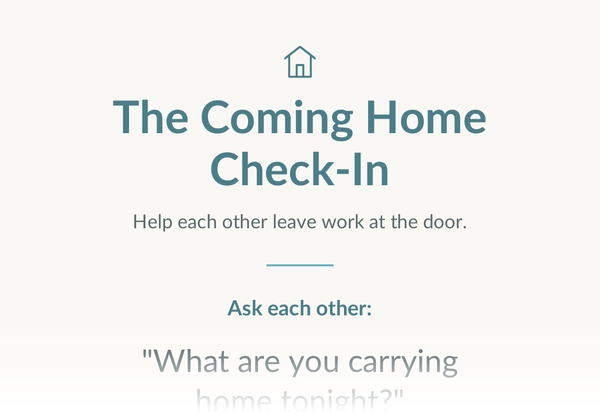
"How was your day?" usually gets "Fine." Try "What are you carrying home tonight?"
Then ask the question that would have saved Theresa and me a few awkward dinners: "What do you need from me right now: listening, help solving it, encouragement, distraction, or space?"
That question keeps you from guessing. Some nights your spouse wants to talk it through. Other nights they need you to talk about anything but work. Both are okay.
In a letter to one of the first churches, the Apostle Paul gave a simple instruction: "Carry each other's burdens" (Galatians 6:2). Asking what your spouse needs, then giving it, is one practical way to do exactly that.
3. Build a bridge between work and home
Coming home is a transition, not an on-off switch. A small ritual can help you set the day down: a walk around the block, ten quiet minutes in the car, a prayer, a cup of coffee together, or naming three things you're grateful for.
When Jesus saw his disciples worn out from serving crowds, he said, "Come with me by yourselves to a quiet place and get some rest" (Mark 6:31). Which ritual you pick matters less than agreeing together on what it's for.
For Theresa and me, the bridge is dinner prep. We've made a habit of treating the first 30 minutes at home as a break from any intense conversation. We cook, talk about lighter things, or just enjoy the quiet.
That half hour gives us a buffer between the workday and whatever the evening holds
Pause and reflect: What do I usually bring home from work? How does my spouse usually respond?
Couple challenge: Pick one of these three practices and try it for the next seven days. Decide together when you'll practice it: at dinner, in the car, or before bed.
When It's More Than a Hard Week
If work stress lingers for weeks, or shows up as numbness, hopelessness, or trouble sleeping, it may be more than a hard season.
Talking with a counselor or your doctor is a wise, healthy step. You don't have to figure it out alone, either.
Our coaches at Encompass Connection Center offer practical tools, support, and encouragement through RINGS for couples, REACH for individuals, and P4KS for parents.
Your first conversation with us is free.
You Don't Have to Carry It Alone
You can't leave every bit of work at the door. But you don't have to carry it alone. A few intentional words and a small ritual can turn the end of a hard day into a moment of connection.
Discussion Questions
What are your early signs that work is weighing on you? Does your spouse know them?
When you're stressed, which do you need most: listening, help solving it, encouragement, distraction, or space?
What small ritual could help you shift from work mode to home mode?
Ready to Build the Connection Your Marriage Deserves?
The RINGS Experience helps couples strengthen communication, navigate conflict, and rebuild emotional connection — with practical tools that work in real life.
• Learn skills for honest, safe conversations
• Understand patterns that may be creating distance
• Build the foundation your relationship was designed to have
→ Take the Free Relationship Assessment
→ Learn About the RINGS Experience
→ Schedule a Free Intake Conversation
Sources referenced:
Bolger, N., DeLongis, A., Kessler, R. C., & Wethington, E. (1989). The contagion of stress across multiple roles. Journal of Marriage and the Family, 51(1), 175–183.
Gupta, A. (2026). Reframing self-care as family care in secondary traumatic stress. NCFR Nexus, Fall 2026. National Council on Family Relations.
Scripture quotations: Galatians 6:2; Mark 6:31 (NIV).