
Why You Can Feel Lonely in a Marriage With No Obvious Problems

By Dr. David Marine Mabry
Encompass Executive Director
Lonely Even When You’re Together
The dishes are done. The house is finally quiet. Dinner was pleasant enough, and now the two of you are on the same couch, a few feet apart, each looking at a screen.
Nothing is wrong.
No one is upset.
And yet you feel alone.
If that moment sounds familiar, you are not the only one. Feeling lonely in marriage is more common than most couples admit, and it is especially confusing when there is no obvious problem to point to.
The encouraging news is that this kind of loneliness usually has a cause you can understand and a way back you can learn.
Why Feeling Lonely in Marriage Isn't About Time Together
We tend to think of loneliness as being by ourselves. But you can spend every evening in the same room with your spouse and still feel unseen.
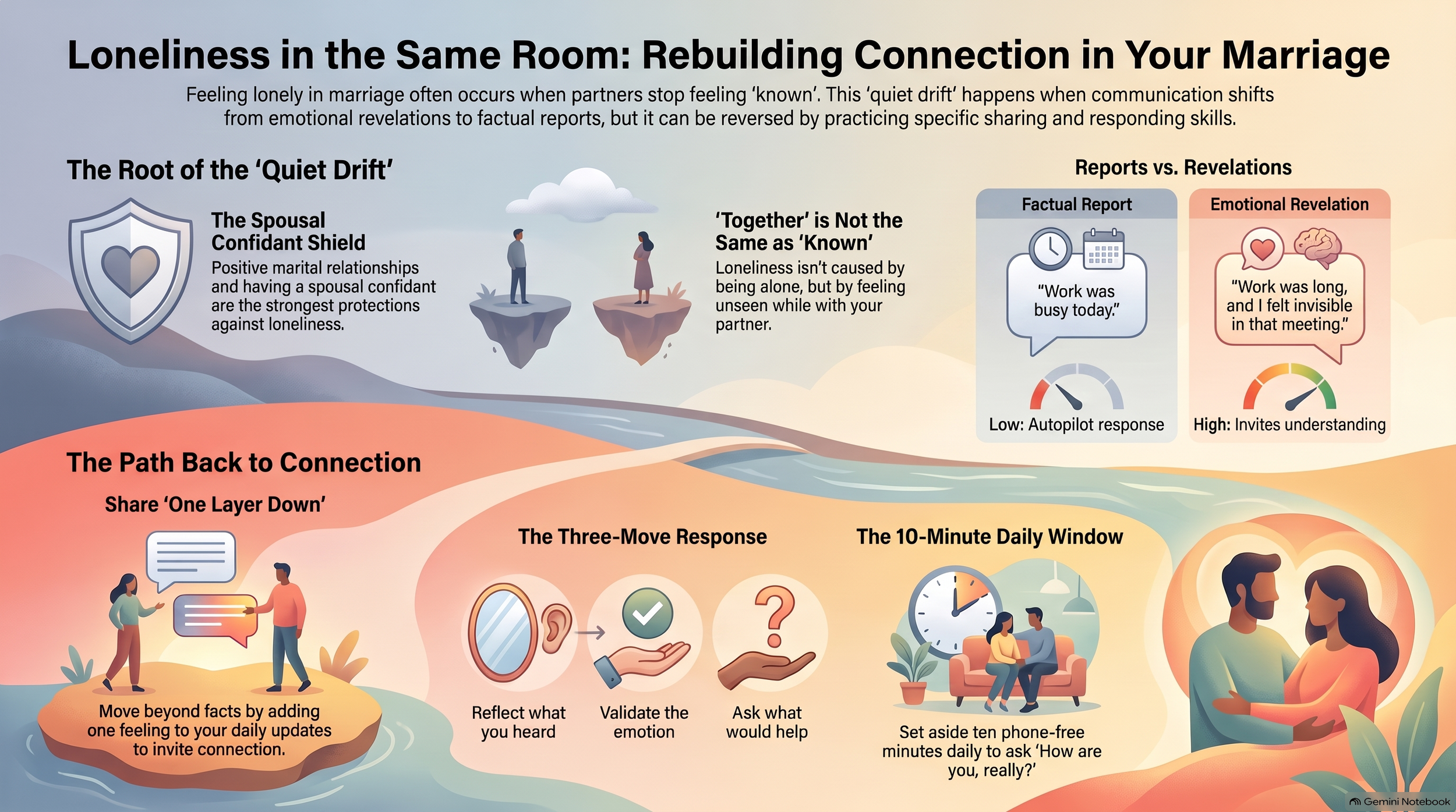
Research points in the same direction. In a University of Chicago study of adults in midlife, positive marital relationships offered the greatest degree of protection against loneliness, and lack of a spousal confidant was among the independent risk factors.
In other words, being married is not what protects us from loneliness. Being close to someone who truly knows us is.
That distinction matters. Loneliness in marriage is not a verdict that your marriage has failed. More often, it is a signal that one or both of you have stopped feeling known.
And feeling known can be rebuilt. It is often the quiet first stage of the drift we describe in our Cornerstone blog on why marriages drift apart.
How Being Known Actually Happens
Closeness grows through a simple two-part exchange.
First, one person shares something real: not just what happened, but what it meant to them.
Second, the other person responds in a way that leaves the first feeling understood, validated, cared for.
When both halves happen regularly, couples feel close. When either half quietly wears down, loneliness can grow even though nothing looks wrong.
Sharing shrinks to facts. "Work was busy." "The car needs tires." "Your mom called." These are real conversations, but they are reports, not revelations.
Research suggests that disclosures of emotional information lead to greater feelings of intimacy than disclosures of factual information. A marriage can be full of talk and still be short on connection.
Responding goes on autopilot. You mention something that has been weighing on you, and your spouse says, "That's rough," without looking up from the phone. Nothing unkind happened.
But you walk away heard, not understood. In my work with couples, loneliness rarely comes from a spouse who doesn't care.
Far more often, it comes from two people who care deeply but have gradually started sharing less and responding faster, without either one deciding to.
Practicing Connection in Ordinary Moments
Both halves of that exchange are skills, and skills can be practiced.
Go one layer down. When you share about your day, add one feeling to the fact.
"Work was long" becomes "Work was long, and I felt invisible in that meeting." That small addition gives your spouse something real to respond to.
Respond with three moves. When your spouse shares, try reflecting what you heard: "It sounds like you felt passed over." Then say why it makes sense: "Of course that stung.
You worked hard on that project." Then ask what would help: "Do you want to talk it through, or do you just need me to listen?"
Name the loneliness without accusation. If you have been feeling alone, say so gently. "I've been missing you, even when we're together" invites closeness.
"You never talk to me anymore" invites defense. One opens a door; the other puts your spouse on trial.
Protect a daily window. Set aside ten minutes a day, phones down, where the question is "How are you, really?" rather than "What's happening tomorrow?"
Ten minutes will not fix everything. But practiced daily, it gives being known a regular place to happen.
These are the same sharing and listening skills couples practice together in the RINGS Experience.
In fact, we encourage a daily practice called The RINGS Chat https://youtu.be/xzBGVIWJEiw?si=pBfF7ERqw6xSor8T
Made for Companionship
In the opening pages of Scripture, after a repeated refrain of "it was good," the first thing God calls "not good" is aloneness: "It is not good for the man to be alone" (Genesis 2:18). Marriage was designed for companionship, not merely a shared address.
Feeling lonely beside your spouse does not mean that design has failed. It means it is worth tending. You do not need a dramatic breakthrough. You need one honest sentence shared and one caring response received, repeated until being known feels normal again.
Talk about it together this week:
When did you last feel truly known by me?
What's one thing on your mind lately that I haven't asked about?
Ready to Build the Connection Your Marriage Deserves?
The RINGS Experience helps couples strengthen communication, navigate conflict, and rebuild emotional connection — with practical tools that work in real life.
• Learn skills for honest, safe conversations
• Understand patterns that may be creating distance
• Build the foundation your relationship was designed to have
→ Take the Free Relationship Assessment
→ Learn About the RINGS Experience
→ Schedule a Free Intake Conversation
Put Intentional Connection Into Practice
Looking for a simple way to be more intentional about your connection? Join Encompass Connection Center’s #DateYourSpouseChallenge
and commit to making time for each other beyond the schedules, responsibilities, and routines of everyday life.
Plan an intentional date with your spouse, take a photo together, and share it on Facebook using #DateYourSpouseChallenge.
Be sure to tag Encompass Connection Center so we can celebrate with you—and challenge another married couple to join in!
Follow the Encompass Connection Center Facebook page to participate, see other couples taking the challenge, and find encouragement to
Keep Dating. Keep Connecting. Keep Thriving.
Sources referenced:
Hawkley, L. C., Hughes, M. E., Waite, L. J., Masi, C. M., Thisted, R. A., & Cacioppo, J. T. (2008). From social structural factors to perceptions of relationship quality and loneliness: The Chicago Health, Aging, and Social Relations Study. The Journals of Gerontology, Series B, 63(6), S375–S384.