Healthy Communication in Marriage: Practical Tools to Build Connection and Trust

By Dr David Marine Mabry
Encompass Executive Director
Most married couples talk every day. They talk about schedules, bills, meals, children, chores, appointments, work, and what needs to happen before the next day begins. But many couples can talk often and still feel unknown. They can share a home, a calendar, a bank account, and a life, while quietly wondering, Does my spouse really understand me? Do they hear what I am trying to say? Are we still emotionally connected?
That is why healthy communication matters so deeply. Communication is not just the exchange of information. It is the pathway by which a husband and wife become known, understood, safe, and connected. Gary Chapman describes communication as involving both self-revelation and listening—one spouse honestly sharing thoughts, feelings, experiences, values, and concerns while the other listens with care and sympathy. In that sense, communication truly is the road to intimacy.
The encouraging news is that healthy communication can be learned. Couples are not stuck with the patterns they inherited, developed, or fell into during stressful seasons. With humility, practice, and the right tools, husbands and wives can learn to slow down, listen more deeply, speak more clearly, repair more quickly, and reconnect more intentionally.
This article offers a practical framework for strengthening communication in marriage. We will look at the climate that makes communication safe, the posture that helps spouses respond rather than react, the skills that build understanding, the patterns that either help or harm connection, and the daily rhythms that keep couples emotionally close over time.
Healthy communication does not require perfection. It begins with a willingness to turn toward each other, tell the truth in love, and keep learning how to understand and be understood.
Create the Right Climate
Every important conversation happens inside a relational climate. Just as weather conditions affect whether it is wise to travel, the emotional climate of a marriage affects whether a conversation is likely to build connection or create more distance.
Many couples assume that if a topic is important, they should push through and talk about it immediately. Sometimes that is true. But often, the wisest first step is not to force the conversation; it is to notice the climate. Are we tired? Defensive? Distracted? Already irritated? Afraid of being blamed? Unsure whether the other person is really listening? If so, even the right words may land poorly.
A healthy communication climate is built on four essential elements: acknowledgment, trust, expectations, and commitment.
Acknowledgment says, “I see you. Your thoughts and feelings matter to me.”
Trust says, “I believe your words, and I believe you care about my good.”
Expectations say, “We are working to clarify what we mean rather than assuming the other person should already know.”
Commitment says, “Even when this is hard, we are on the same team.”
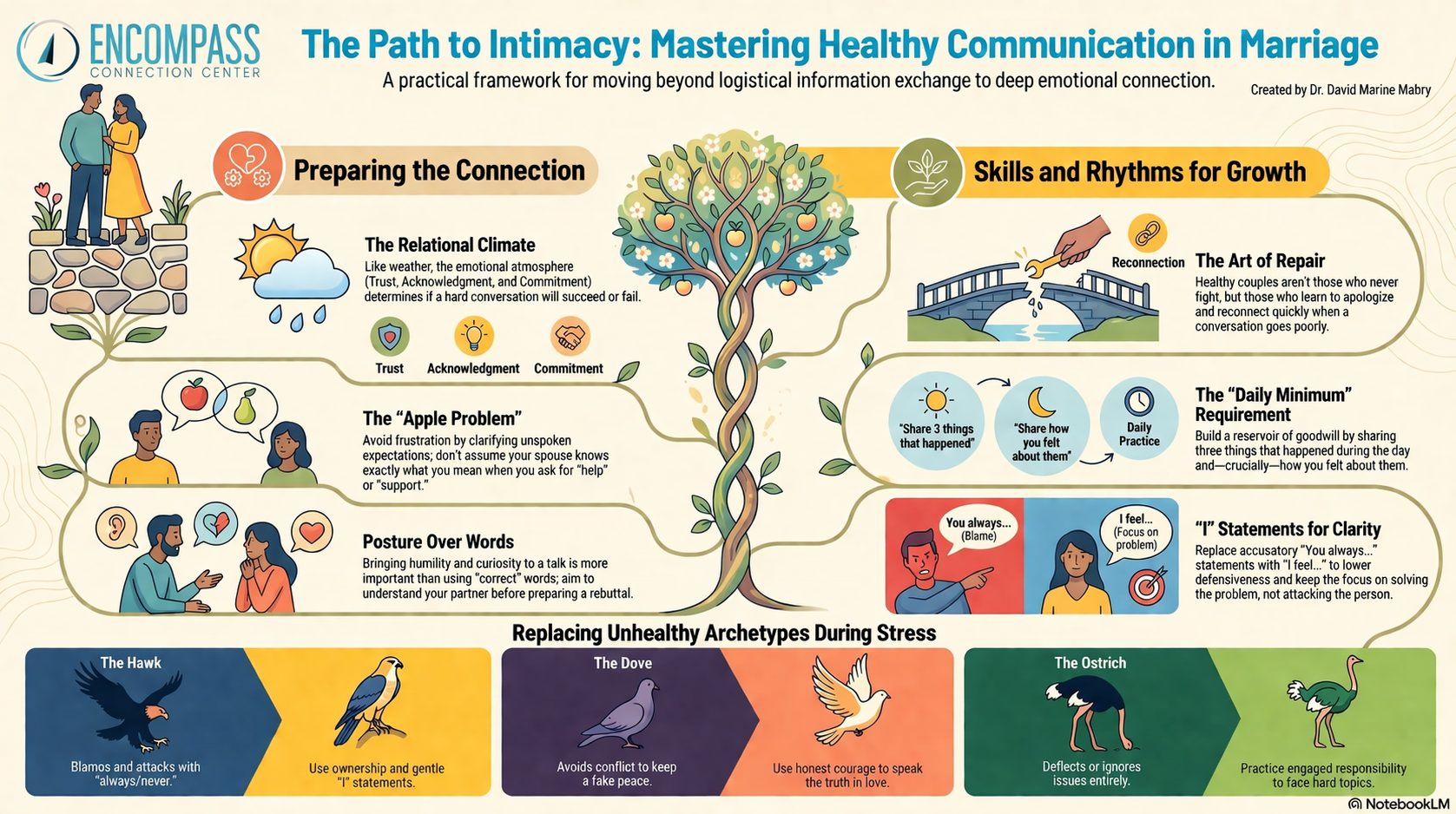
This is where many couples run into what we might call the “apple problem.” One spouse says, “Can you bring home some apples?” The other brings home green apples, only to discover that red apples were expected. The issue is not really apples. The issue is unspoken expectations. Marriage is full of “apple moments”: “Help more around the house,” “Be more supportive,” “Spend more time with me,” or “Let’s be better with money.” These phrases sound clear, but they may mean something very different to each spouse.
Healthy communication grows when couples learn to clarify before they criticize. Instead of assuming, ask, “What does that mean to you?” “Can you give me an example?” “What would feel helpful?” “What are you hoping for?” Clarity lowers frustration and creates safety.
A wise word spoken at the right time can be beautiful and life-giving. But the timing, tone, and climate matter. Before entering a hard conversation, couples do well to ask, “Is this a good time to talk?” and “How can we approach this in a way that helps both of us feel heard?”
Practice the Right Posture
Healthy communication is not only about using the right words. It is also about bringing the right posture into the conversation. Two people can say technically correct things and still damage each other if the tone is harsh, the timing is poor, or the goal is to win rather than understand.
The posture that strengthens communication begins with humility. Humility says, “I may not fully understand yet.” It is willing to ask one more question before drawing a conclusion. It recognizes that my spouse’s experience may be different from mine, even when we are living through the same situation.
Healthy communication also requires curiosity. Curiosity asks, “Help me understand what this means to you.” It resists the temptation to assume motives, finish sentences, or prepare a rebuttal while the other person is still talking. Curiosity does not mean agreement; it means I care enough to understand before I respond.
Ownership matters as well. Instead of placing all the blame on a spouse, ownership asks, “What part of this belongs to me?” It is the difference between saying, “You always make this difficult,” and saying, “I realize I came into this conversation already defensive.” That kind of honesty can lower the emotional temperature quickly.
Honor is another essential posture. In marriage, your spouse is not your enemy. Even in disagreement, he or she is someone to be treated with dignity, care, and respect. Couples who communicate well learn to attack the problem without attacking the person.
Finally, healthy communication requires self-control. Between what your spouse says and how you respond, there is a space. In that space, you can choose whether to react out of fear, anger, defensiveness, or pride—or respond with wisdom. Sometimes the most loving thing you can say is, “I want to respond well, but I need a few minutes to calm down.”
A pause is not avoidance when it is used to return with maturity. Wise couples learn that the goal is not to say everything they feel in the moment. The goal is to speak in a way that helps both people move toward understanding, repair, and connection.
Use the Right Skills
Once the climate is safe enough and the posture is humble enough, couples can begin practicing the skills that make communication healthier. These skills are not complicated, but they do require intention. Most couples do not drift into healthy communication by accident. They grow into it through repeated practice.
The first skill is listening to understand. This means giving your spouse your full attention, putting away distractions, and listening for more than the words being spoken. What is the feeling underneath the words? What is the concern? What is the hope? What is the fear? A spouse who says, “You never help around here,” may be saying something deeper: “I feel alone,” or “I feel overwhelmed,” or “I need to know we are partners.” Listening well means slowing down long enough to hear the message beneath the message.
One practical way to do this is to reflect back what you heard: “What I hear you saying is…” or “It sounds like you felt…” Then ask, “Did I understand that correctly?” This simple step can prevent a conversation from spiraling into unnecessary defensiveness.
The second skill is asking better questions. Many couples ask questions that are really accusations: “Why would you do that?” “What were you thinking?” “Why can’t you ever remember?” Healthier questions invite understanding: “Can you help me understand what happened?” “What were you hoping for?” “What did that feel like to you?” “What do you need from me right now?” A good second question often opens a door that a quick reaction would have slammed shut.
The third skill is speaking clearly and honestly. Healthy communication does not require spouses to hide what they think or feel. But it does require them to speak in a way that can be received. Instead of saying, “You don’t care about me,” try, “I felt unimportant when we didn’t talk last night.” Instead of, “You always make things harder,” try, “I am feeling overwhelmed, and I need us to make a plan together.” Clear speech is honest, specific, and responsible.
The fourth skill is sharing more than facts. Many couples communicate at the level of logistics: who is picking up the kids, what bills need paid, what time the appointment starts, or what needs done before the weekend. Those conversations matter, but they do not create deep intimacy by themselves. Couples also need to share thoughts, feelings, hopes, disappointments, desires, and concerns. A marriage cannot be nourished by information alone.
Finally, couples need the skill of repair. Even with good tools, conversations will sometimes go poorly. Someone will interrupt, assume, overreact, shut down, or speak too sharply. Repair sounds like: “I’m sorry. That came out wrong.” “Can I try that again?” “I got defensive.” “I misunderstood you.” “I still love you, and I want to work through this.” Healthy couples are not couples who never miss each other. They are couples who learn how to come back, repair, and reconnect.
Recognize and Replace Unhealthy Patterns
Most couples do not struggle with communication because they have bad intentions. They struggle because, over time, they develop patterns. Some patterns create safety and connection. Others create distance, defensiveness, resentment, or emotional shutdown.
Gary Chapman describes several unhealthy communication patterns with memorable images: the dove, the hawk, the owl, and the ostrich. These pictures help couples identify what they tend to do under stress.
The dove wants peace at any price. This spouse avoids disagreement, says “whatever you want,” apologizes quickly, and tries to keep the relationship calm. On the surface, this may look loving. But if the dove never speaks honestly, peace is purchased at the cost of intimacy. Over time, avoidance can become resentment. The dove needs to replace silence with honest courage. A healthier sentence might be, “I don’t want to fight, but I do need to be honest about how I feel.”
The hawk blames, criticizes, and attacks. This spouse may use words like “always” and “never,” quickly pointing out what the other person did wrong. The hawk may feel powerful in the moment, but blame rarely creates understanding. It usually produces defensiveness, fear, or counterattack. The hawk needs to replace blame with ownership and gentleness. A healthier sentence might be, “I am upset, but I want to talk about this without attacking you.”
The owl appears calm, reasonable, and logical, but often stays emotionally distant. This spouse may explain, analyze, or lecture without revealing much feeling. Logic matters, but when reason becomes a shield against vulnerability, the other spouse may feel dismissed or alone. The owl needs to replace detached explanation with emotional presence. A healthier sentence might be, “I can explain what I think, but I also want to tell you what I’m feeling.”
The ostrich avoids, deflects, changes the subject, or acts as though the issue will disappear if it is ignored. This may reduce tension temporarily, but unresolved issues do not usually go away. They settle into the relationship and become barriers to closeness. The ostrich needs to replace avoidance with engaged responsibility. A healthier sentence might be, “This is uncomfortable, but I know we need to talk about it.”
The goal of naming these patterns is not to label or shame one another. The goal is to grow. A couple might even ask, “Which pattern do I tend to fall into when I am stressed?” and “What would a healthier response look like?” Patterns can be learned, which means they can also be unlearned. With patience, humility, and practice, couples can replace old habits with new ways of speaking, listening, and reconnecting.
Build Daily Rhythms of Connection
Healthy communication is not built only during serious conversations. It is built in the small, repeated moments that tell a spouse, “You matter to me. I am paying attention. I still want to know you.”
This is important because many couples wait until something is wrong to have a meaningful conversation. By then, the emotional climate may already be tense. Daily rhythms of connection create a reservoir of goodwill, trust, and warmth that helps couples navigate harder conversations when they come.
One simple practice is a daily sharing time. Gary Chapman recommends what he calls a “daily minimum requirement”: each spouse shares three things that happened that day and how they felt about them. This is simple enough for any couple to practice, but meaningful enough to move beyond logistics. The goal is not to report every detail of the day. The goal is to let your spouse into your inner world.
Another rhythm is daily appreciation. A simple “thank you for making dinner,” “I noticed how patient you were with the kids,” or “I appreciate how hard you worked today” can soften the climate of a home. Appreciation reminds couples to look for what is good, not only what is frustrating.
Couples also benefit from intentional moments without technology. Phones, television, and constant notifications can quietly train spouses to give each other divided attention. A short no-phone conversation, a walk after dinner, or a few minutes together before bed can become a powerful act of reconnection.
For couples who share faith, prayer can also be a meaningful rhythm. It does not need to be long or formal. A brief prayer of gratitude, concern, or blessing can help spouses slow down, remember what matters, and invite God into the ordinary realities of married life.
Finally, couples need regular check-ins. A weekly conversation can ask: “How are we doing?” “Is there anything we need to talk about before it becomes bigger?” “How can I support you this week?” “What is one thing we are grateful for right now?” These questions help couples tend the relationship before neglect becomes distance.
Strong marriages are not built by dramatic moments alone. They are built by small, faithful practices repeated over time. One better conversation, one thoughtful question, one expression of appreciation, one repair, one prayer, and one moment of focused attention can become the rhythm by which communication grows healthier and intimacy grows stronger.
At Encompass Connection Center, our RINGS Experience helps couples practice research-informed relationship skills in a practical, encouraging format. If you and your spouse want to strengthen communication, conflict resolution, and connection, RINGS may be a helpful next step. Learn More About RINGS
When to Ask for Help
Many couples can make real progress by practicing the tools in this article. A calmer tone, a better question, a clearer expectation, or a more consistent rhythm of connection can make a meaningful difference. But there are also times when a couple should not try to carry the communication struggle alone.
Outside help may be wise when the same argument keeps repeating without resolution, when one or both spouses regularly shut down or explode, when trust has been broken, or when important topics are avoided because they feel too painful or too risky. Help may also be needed when conversations quickly become contemptuous, intimidating, or emotionally unsafe.
It is especially important to say this clearly: healthy communication tools are not a substitute for safety. If there is abuse, coercion, intimidation, ongoing betrayal, or fear of speaking honestly, the first priority is not simply better communication. The first priority is safety, wisdom, and appropriate support.
For many couples, however, seeking help is not a sign that the marriage is failing. It is often a sign that the couple is ready to grow. A trained counselor, pastor, mentor couple, marriage coach, or relationship education program can help spouses slow down the conversation, recognize patterns, rebuild trust, and learn skills they may never have been taught.
Every couple gets stuck at times. The question is not whether you will ever need help. The question is whether you are willing to receive the help that can move you toward greater health. Sometimes the most hopeful sentence a couple can say is, “We do not want to keep doing this the same way. Let’s get some help.”
Some couples benefit from having a trained guide help them slow down the conversation, identify patterns, and practice healthier ways to connect. Encompass offers relationship education and coaching options designed to help couples grow with hope and clarity.Explore Marriage Support
One Better Conversation at a Time
Healthy communication in marriage is not a destination couples reach once and then never have to revisit. It is a way of loving each other over time. It grows as spouses learn to create a safer climate, bring a healthier posture, practice better skills, replace harmful patterns, and build daily rhythms of connection.
No couple does this perfectly. Every husband and wife will have moments when they misunderstand, interrupt, assume, overreact, withdraw, or speak too sharply. But healthy couples learn to notice those moments and return to each other. They learn to say, “I did not handle that well.” “Can we try again?” “Help me understand.” “I still love you, and I want us to work through this.”
That is encouraging because it means growth can begin with one small step. One clarifying question can prevent an argument. One pause can keep a reaction from becoming a wound. One honest statement can open the door to deeper understanding. One apology can begin repair. One daily check-in can rebuild warmth where distance has started to grow.
Marriage is not strengthened by perfect communication. It is strengthened by two people who keep choosing to turn toward one another with honesty, humility, patience, and care. Healthy communication is learnable, and every couple can begin practicing it one conversation at a time.
A relationship assessment can help couples identify strengths, growth areas, and specific communication patterns. This can be especially helpful for couples who want a clearer starting point.Take the Next Step
Sources Consulted
Gary Chapman, Covenant Marriage, especially the chapters on communication as the road to intimacy, unhealthy communication patterns, and five levels of communication. Chapman’s work helped shape this article’s emphasis on communication as self-revelation, sympathetic listening, and a pathway to intimacy.
Tim Muehlhoff, Marriage Forecasting, especially the framework of communication climate: acknowledgment, trust, expectations, and commitment. This article’s use of “communication climate” and its emphasis on timing, trust, expectations, and relational environment are informed by Muehlhoff’s work.
Mike Bechtle, “6 Tools for Healthy Communication in Marriage,” Focus on the Family. Bechtle’s article informed the discussion of focused attention, clear expectations, second questions, technology boundaries, daily connection habits, and appreciation.
David J. Ayers, Christian Marriage, especially the discussion of good communication, conflict management, honesty, shared spiritual practices, and marital satisfaction.
The Gottman Institute, “10 Communication Exercises for Couples to Have Better Relationships.” This resource informed the article’s emphasis on active listening, emotional validation, repair, daily conversations, and turning toward one another.
One Love Foundation, “5 Easy Ways to Communicate Better in Your Relationships.” This resource reinforced the importance of open-ended questions, nonverbal awareness, direct communication, and two-way conversation.
Johns Hopkins Student Well-Being, “Communication in Relationships Doesn’t Have to Be Scary.” This resource supported the article’s emphasis on choosing the right time, preparing for hard conversations, and listening with curiosity.
Verywell Mind, “Managing Conflict in Relationships: Communication Tips.” This resource informed the discussion of staying focused, using “I” statements, taking breaks, and seeking compromise.
University of Michigan Human Resources, “Nine Practical Communication Tips for Couples.” This resource reinforced practical listening, reflection, validation, and emotional check-in practices.
The JED Foundation, “How to Improve Communication Skills in Your Relationship.” This resource informed the article’s emphasis on self-awareness, boundaries, and “us against the problem” thinking.
Dr. Ali Sager, “Building Healthy Communication Patterns in Relationships.” This resource supported the discussion of recurring conflict patterns, emotional safety, and the value of seeking help when negative patterns persist.